
The best time to visit Cambodia is narrower than the brochures suggest. November brings full moats, green rice fields and thinner crowds at Angkor, before the December rush arrives.
The short answer is November
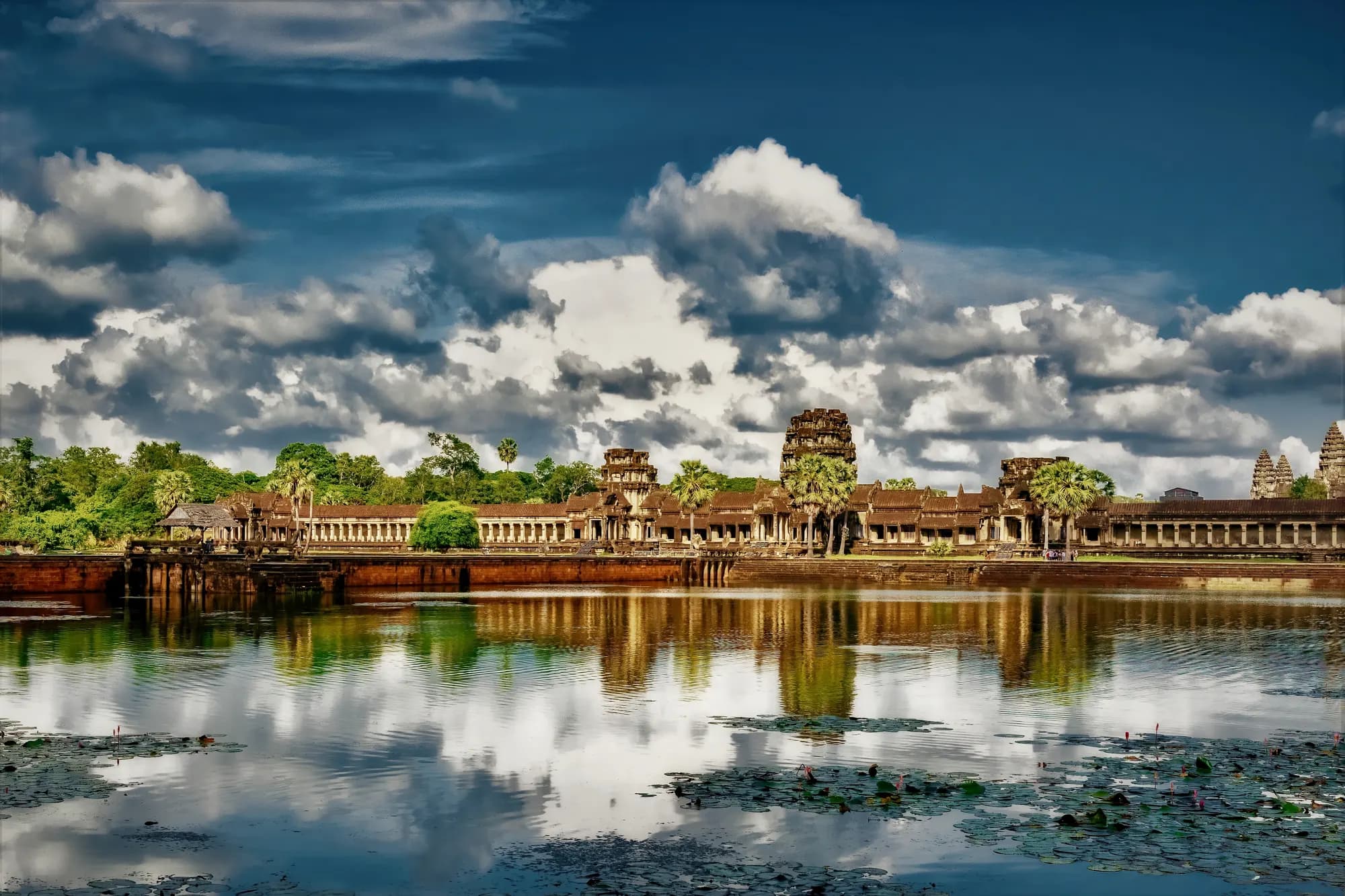
If you want one month, take November. The rains have mostly finished, the countryside is still green from five months of weather, the moats around Angkor are full, and the temperature has dropped out of the punishing band it occupies from March to May. The peak-season crowds that define December and January have not yet arrived in force. It is the brief window where Cambodia's climate, its landscape and its visitor numbers all line up, and it does not last long.
The honest catch is that November is no secret. Flights and the better rooms around Siem Reap fill months ahead, and an unseasonal late shower is still possible in the first half of the month. But a shower that clears by mid-afternoon is a fair exchange for full reservoirs and rice fields at their greenest. If your dates are fixed elsewhere in the year, the rest of this piece maps the trade-offs, month by month.
The best time to visit Cambodia, season by season
Cambodia keeps things simple: a dry season from roughly November to April and a wet season from May to October. Within the dry half there are really two seasons. November to February is warm rather than hot, with low humidity and reliable blue sky. March and April turn fierce, with afternoon temperatures at Angkor often pushing towards forty degrees. The wet half is gentler than its name suggests, with rain arriving mostly as short, heavy afternoon bursts rather than washed-out days.
So the question of the best time to visit Cambodia is really a question about what you are willing to trade. Cool, dry and crowded from December to February. Hot and quiet in April. Green, wet and almost empty from June to September. November takes a little from each column, which is why it wins. The one period worth planning around carefully is the Khmer New Year holiday in April, when much of the country closes and travels home to family.
December to February, the comfortable compromise
December to February is when most visitors come, and the weather explains it. Mornings can be genuinely cool, especially in December and January, humidity sits at its lowest of the year, and rain is rare enough to ignore. For temple days that start before dawn and involve hours on foot, this matters. It is also the best window for combining Angkor with the coast, since the islands off Sihanoukville and the beaches around Kep share the same dry, settled pattern.
The cost is company. Angkor Wat at sunrise in January is an event with an audience, and the headline temples are busy from mid-morning onwards. A good guide routes around the worst of it, working the circuit in reverse and saving the famous facades for lunchtime, when the coach groups retreat to town. Book flights and rooms several months out for this window, and treat the week either side of Christmas as its own high season within the high season.
The green season is a better idea than it sounds
From June to September, Angkor belongs to whoever bothers to come. Visitor numbers fall away, the moats and reservoirs fill, and the stone sits against green rice paddies instead of brown scrub. Photographers quietly prefer it. The rain is real but organised: most days deliver a single storm in the mid to late afternoon, which is precisely when sensible people are back at the pool anyway. We have made the case for shoulder and off seasons before, and Cambodia is one of its best arguments.
The catch arrives if you push beyond the temples. Remote roads in Ratanakiri and Mondulkiri can become slow or impassable at the height of the rains, September and October are the wettest months, and the coast loses its appeal when the sea turns rough. So the green season suits a trip built around Siem Reap, Phnom Penh and Battambang, places with sealed roads and good shelter, rather than an ambitious loop through the far provinces.
| Months | Weather | At Angkor |
|---|---|---|
| November | Rains easing, landscape green | Full moats, crowds still building |
| December to February | Cool, dry, low humidity | Best weather, busiest temples |
| March to May | Hot, hazy, dry | Quiet, but plan around midday heat |
| June to September | Afternoon storms, lush | Green and near-empty |
| October | Wettest weeks, tapering late | Moats brimming, few visitors |
Angkor is not the whole calendar
The coast runs on the same clock as the temples but punishes mistakes more. The islands off the south coast are at their best from late November to April, when the sea is calm and crossings are easy; by June the swell builds and some island properties simply close for the season. If a beach finish matters, and for honeymooners it usually does, anchor the trip in the dry months. Cambodia's islands earn their place on the 2026 honeymoon shortlist precisely because they remain undeveloped and quiet.
Tonle Sap, the great lake below Siem Reap, runs the opposite way. It swells to several times its dry-season size during the rains, and the floating villages are at their most navigable, and their most photogenic, from August to November, when boats glide over what was farmland in March. Visit late in the dry season and the same trip involves a long, dusty drive to reach the receded waterline. It is the clearest example of how one Cambodian date changes two different trips.
How JMJ plans a Cambodia trip
We start with the month, not the map. If your dates are open, we will steer you towards November, or towards the green season if quiet temples matter more to you than a guaranteed dry afternoon. If your dates are fixed by school terms or leave, we shape the trip to fit: early starts and pool afternoons in the hot months, a coast finish only when the sea allows. Cambodia rewards fewer places and longer stays, and three unhurried nights at Angkor beat five towns in a week.
A typical shape is seven to ten nights: Siem Reap first, then Phnom Penh, then either the coast or the countryside depending on the season, with about seven hours of flying from Dubai, usually through one regional hub. We arrange guides who know the quiet hours at each temple, which matters more than anything else you can book. Tell us your month and who is travelling on our enquiry page, and we will tell you honestly what that month gives up.
Frequently asked
What is the best time to visit Cambodia?
For most travellers the best time to visit Cambodia is November. The rains have largely finished, the landscape is still green, the moats at Angkor are full and the December crowds have not yet arrived. December to February offers the most reliable weather if comfort is the priority, and June to September suits anyone who values quiet temples over a guaranteed dry afternoon.
When is the best time to visit Angkor Wat?
November and early December are the sweet spot for Angkor Wat: full moats, green surroundings and manageable crowds. December and January bring the coolest, driest mornings but also the largest visitor numbers. Whatever the month, the temples are at their best in the first two hours after opening, so the honest answer is as much a time of day as a time of year.
Is the rainy season a good time to visit Cambodia?
Better than its reputation. From June to September rain usually falls as one heavy storm in the mid to late afternoon, leaving mornings clear for the temples. Visitor numbers drop sharply, the countryside turns green and the Tonle Sap floating villages are at their fullest. The trade-offs are rougher seas on the coast and slow going on remote provincial roads, so keep a wet-season trip to the main centres.
What is the hottest month in Cambodia?
April is generally the hottest month, the peak of a hot season that runs from March to May, with afternoon temperatures at Angkor often pushing towards forty degrees. It is still workable if you plan the way locals do: temples at dawn, a long rest through the middle of the day, and a second outing near sunset. The upside is that crowds thin considerably before the rains arrive.
Is December a good time to visit Cambodia?
Yes, December has arguably Cambodia's best weather: cool mornings, low humidity and almost no rain. It is also the busiest month, with the headline temples crowded from mid-morning and the days around Christmas and New Year forming a peak within the peak. Book flights and rooms several months ahead and lean on a guide who can route you against the flow of the big groups.
When is the best time to visit Cambodia's beaches and islands?
Late November to April. The sea is calm, the sky is settled and the boat crossings to the southern islands are straightforward. From May the swell builds, the rain increases, and by the wettest months some island properties close entirely. If a beach finish is part of the plan, that alone can decide when you take the whole trip.
How many days do you need in Cambodia?
Seven to ten nights is the comfortable range. Three nights around Siem Reap lets you take Angkor slowly rather than in one exhausting day, two or three nights in Phnom Penh cover the capital, and the remainder goes to the coast in the dry season or the countryside in the green season. A shorter five-night trip works, but only if you accept it is really an Angkor trip with a stopover.
What is the cheapest time of year to visit Cambodia?
The green season, roughly June to September, is when demand across Cambodia is at its lowest and rates soften accordingly, so the gap between what you pay and what you experience is at its widest. You give up guaranteed dry afternoons and the coast, but the temples are quiet and the landscape is at its greenest. September and October are the wettest months, so earlier in the season is the safer bet.