A month by month guide to planning a great migration safari, from calving season in the southern Serengeti to the Mara River crossings in Kenya. Where the herds are, and when to go.
The migration is one loop, not one event
JMJ Experiences designs private safaris around the Great Migration, a year-round loop in which close to two million wildebeest, zebra and gazelle circle between Tanzania's Serengeti and Kenya's Masai Mara. The migration never truly stops. The herds follow the rains, calving in the south early in the year and pushing north toward the Mara River by the middle of the year.
This matters for planning. A great migration safari is really a question of timing, not a single destination. The great serengeti migration and the crossings in the Masai Mara are two chapters of the same story, months and hundreds of kilometres apart. Knowing the wildebeest migration month by month is how you place yourself where the animals actually are.
How to read the migration month by month
Wildebeest migration timing is driven by rainfall, so exact dates move each year. The pattern, though, is dependable. Calving comes first, in the southern Serengeti. The herds then move northwest through the central and western plains. By mid-year they reach the north, and the Mara River crossings begin. Late in the year they turn south again.
The calendar below is the shape of a typical year. Treat it as a guide, not a timetable. We build every itinerary around the current season and the latest movement reports, then position your camps accordingly.
| Month | Where the herds are | What happens |
|---|---|---|
| January | Southern Serengeti and Ndutu plains (Tanzania) | Herds gather on the short-grass plains as the rains green the south. Calving season begins. |
| February | Southern Serengeti and Ndutu | Peak calving in the Serengeti. Several hundred thousand calves are born within a few weeks. Predator activity is high. |
| March | Southern Serengeti, starting to move west | Calving tails off. The herds begin to drift northwest as the plains dry. |
| April | Central and western Serengeti | The long rains fall. Columns move steadily northwest. Quieter, greener, fewer vehicles. |
| May | Western Serengeti, toward the Grumeti | The northward push gathers pace. The rut begins. First Grumeti River crossings can occur. |
| June | Grumeti and northern Serengeti | Herds mass along the Grumeti River. The dry season sets in and the move north continues. |
| July | Northern Serengeti and Masai Mara (Kenya) | The first Mara River crossings usually begin as the herds reach the Kenya border. |
| August | Masai Mara and northern Serengeti | Mara River crossings are frequent. Prime time in the Mara. |
| September | Masai Mara | Crossings continue back and forth across the river. The Mara holds large concentrations. |
| October | Masai Mara, starting to move south | Late crossings. As the short rains approach, the herds begin turning south. |
| November | Northern Serengeti, moving south | The short rains draw the herds back into Tanzania. The southward drift is under way. |
| December | Central and southern Serengeti | Herds spread back across the southern plains, readying for the next calving season. |
Calving season in the southern Serengeti (January to March)
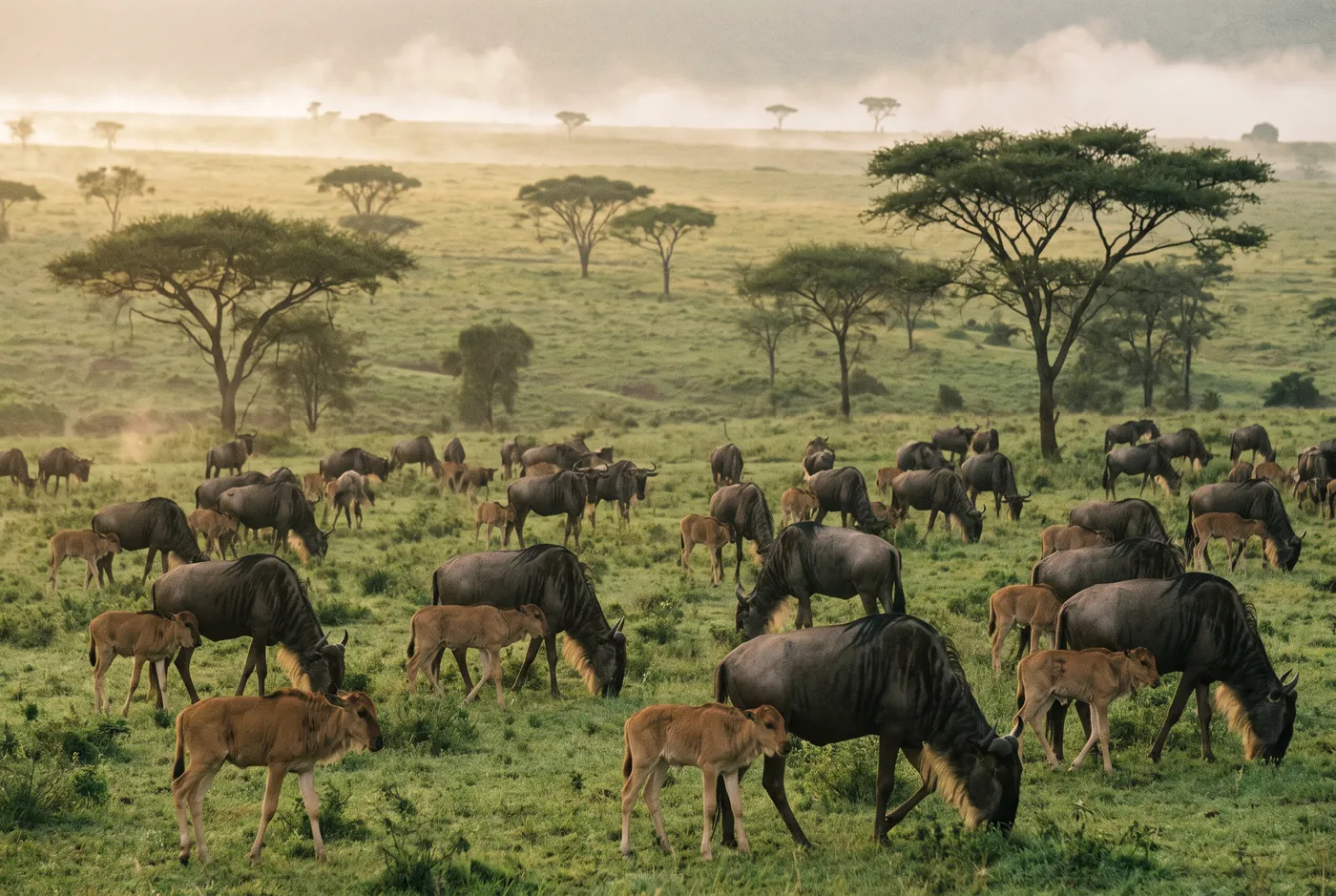
The Serengeti calving season is the year's quiet spectacle. On the short-grass plains around Ndutu and the southern Serengeti, several hundred thousand wildebeest calves are born within a few weeks, usually late January to March. The grazing is rich, the herds are settled, and the plains stay green.
The density of newborns draws predators, so this is one of the strongest windows for big cats. It is a gentler, less crowded time than the crossings, which suits families well. Our luxury family safari guide covers how we pace these days for younger travellers.
The northward push and the Grumeti (April to June)
As the plains dry, the herds move northwest in long columns through the central and western Serengeti. This is the green, quiet heart of the year. The long rains fall in April, vehicles are few, and the landscape is at its most photogenic.
By May and June the columns mass along the Grumeti River, the first major water barrier of the loop. The rut is under way, and the sound of the herds carries for miles. Crossings here are smaller than the Mara crossings to come, though no less compelling.
The Mara River crossings (July to October)
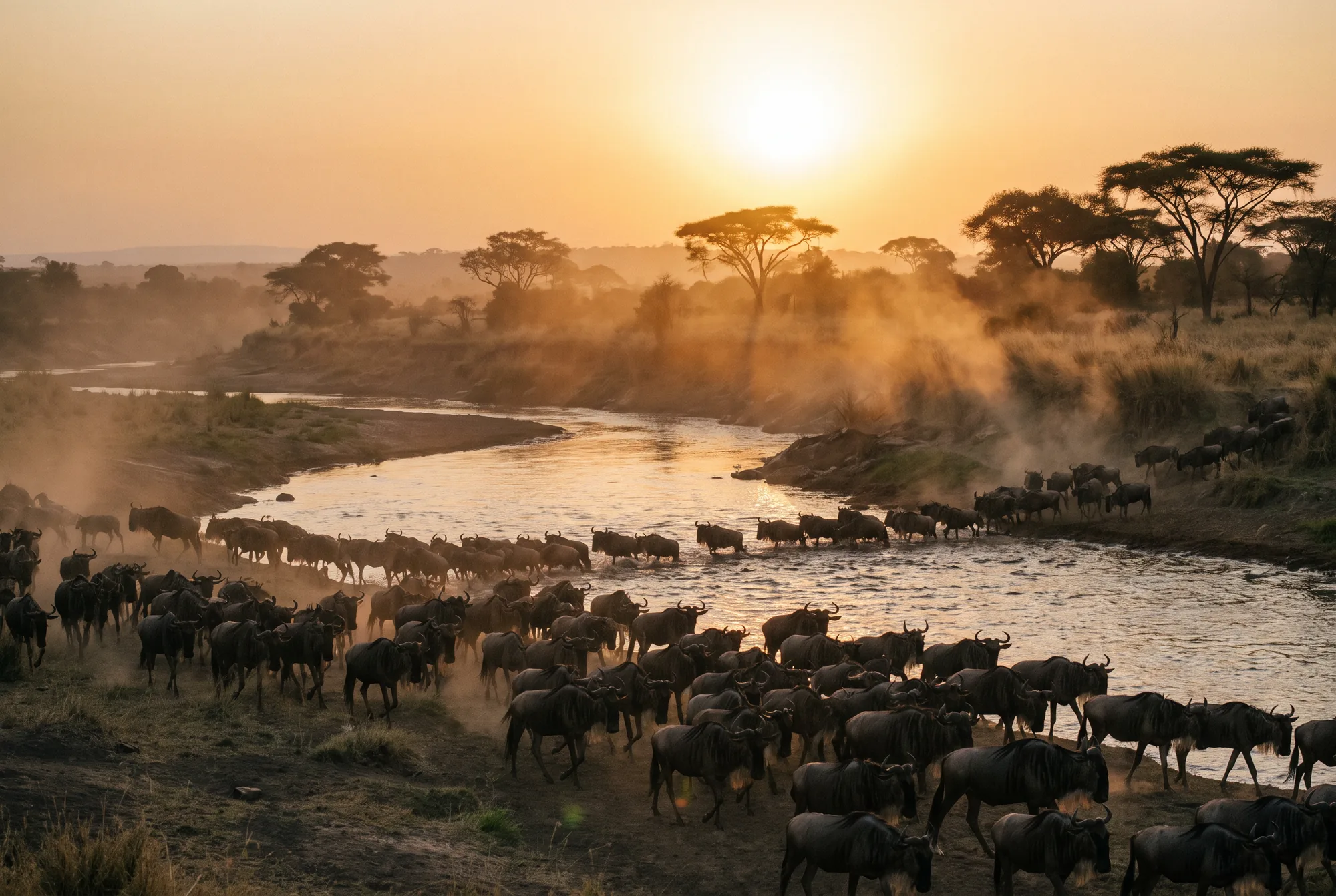
The Mara River crossings are the image most people hold of the migration in Mara country. From roughly July, the herds reach the northern Serengeti and cross into Kenya's Masai Mara. Wildebeest gather on the banks in their thousands, hesitate, then surge across water that holds large crocodiles.
Crossings are unpredictable. They can happen at any point from July to October, sometimes several times as the herds move back and forth chasing grazing. This is the busiest and most sought-after window, so the best camps in the Mara are reserved far ahead. See our best time to go on safari in Kenya for how the crossings sit within the wider season.
The return south (November to December)
As the short rains arrive around November, the herds turn south again, drifting out of the Mara and back through the northern and central Serengeti. By December they are spreading across the southern plains once more, readying for the next calving season. The circle closes and begins again.
These shoulder months are underrated. The landscape is fresh, the light is soft, and the herds are on the move without the crowds of the crossing season.
Planning a Great Migration safari
Because the migration crosses a border, the best trips are built around timing first and geography second. For calving and the quieter months, we base you in Tanzania. For the crossings, we base you in Kenya. Many travellers eventually do both, whether across two journeys or one longer loop. Our guide to Kenya versus Tanzania safari weighs the two sides in detail.
A well-run great migration safari is as much about the camps as the animals: small, well-placed properties that move with the season and give you the herds close and largely to yourself. For the full picture, read how to plan a luxury Kenya safari and how much a luxury safari costs, or tell us your dates and we will build the year around them.
Frequently asked
When is the Great Migration?
The Great Migration runs year-round. The herds never stop moving. They circle between Tanzania's Serengeti and Kenya's Masai Mara following seasonal rains. Calving falls roughly January to March in the southern Serengeti, and the Mara River crossings fall roughly July to October. Timing shifts each year with the weather.
When do wildebeest migrate, and does the migration ever stop?
The wildebeest migrate continuously, so the migration never truly ends. Around two million wildebeest, zebra and gazelle move in a slow loop dictated by rainfall and fresh grazing. There is no start or finish line. What changes month to month is where the herds are and what they are doing.
When is the best time to see the Great Migration?
For calving and predator action, visit the southern Serengeti from late January to March. For the Mara River crossings, the drama most travellers picture, aim for July to October in the Masai Mara. The best time to see the Great Migration depends on which chapter you want to witness.
Where is the best place to see the Great Migration?
There is no single best place, because the herds move across two countries. The southern Serengeti is best for calving early in the year. The Masai Mara is best for the river crossings from July to October. A well-timed itinerary matches your camp to where the herds will be.
When does the wildebeest migration start?
The migration has no fixed start, since it is a continuous circle. If a starting point helps, calving season in the southern Serengeti, roughly January to March, is often treated as the beginning. From there the herds move northwest, reaching the Mara River crossings by the middle of the year.
What is the Serengeti calving season, and when does it happen?
Calving season is the few weeks when the wildebeest give birth on the short-grass plains of the southern Serengeti and Ndutu. It falls roughly late January to March. Several hundred thousand calves arrive within a short window. The concentration of young draws lions, cheetah and hyena, so predator sightings peak.
When are the Mara River crossings?
The Mara River crossings fall roughly July to October, when the herds reach the northern Serengeti and the Masai Mara. Crossings are not scheduled. Wildebeest mass on the banks, then plunge across in unpredictable bursts, sometimes several times in a season as they move back and forth chasing grazing.
Serengeti or Masai Mara: which side should I base on?
Base in Tanzania's Serengeti for calving and the quieter first half of the year. Base in Kenya's Masai Mara for the river crossings from July to October. The right side depends on when you travel. Many travellers combine both, across two trips or one longer journey, to follow the herds properly.