
Everyone arrives in Dubai expecting the tallest, the biggest, the most gold. The city we have come to love is older and quieter than that (the smell of cardamom on the night air, silence in the dunes at dusk), and you can find it in an afternoon, if you know to cross the water.
The reputation problem
Dubai has spent two decades being described in superlatives, and the descriptions have done it a quiet disservice. It is the city of the tallest tower, the largest mall, the indoor ski slope in the desert. The shorthand is accurate as far as it goes, but it leaves most travellers expecting a place that is impressive and a little hollow: a departures lounge with a skyline, somewhere you pass through on the way to somewhere with more soul. We understand the assumption: the first hour from the airport, gliding past glass towers on a twelve-lane road, does little to argue against it.
But the spectacle is the youngest layer of a place older and more human than its marketing suggests. Fifty years ago this was a town of mud-brick houses and pearling dhows clustered along a tidal creek, trading with India, East Africa and Persia long before anyone struck oil. That town is still here. It did not get bulldozed; it got bypassed. The towers went up on new ground to the south, and the old quarter by the water was left to itself, then carefully restored. If you only see the Dubai of the postcards, you will conclude there is nothing underneath. There is. You simply have to cross the creek to reach it.
Across the water: the old city most visitors skip
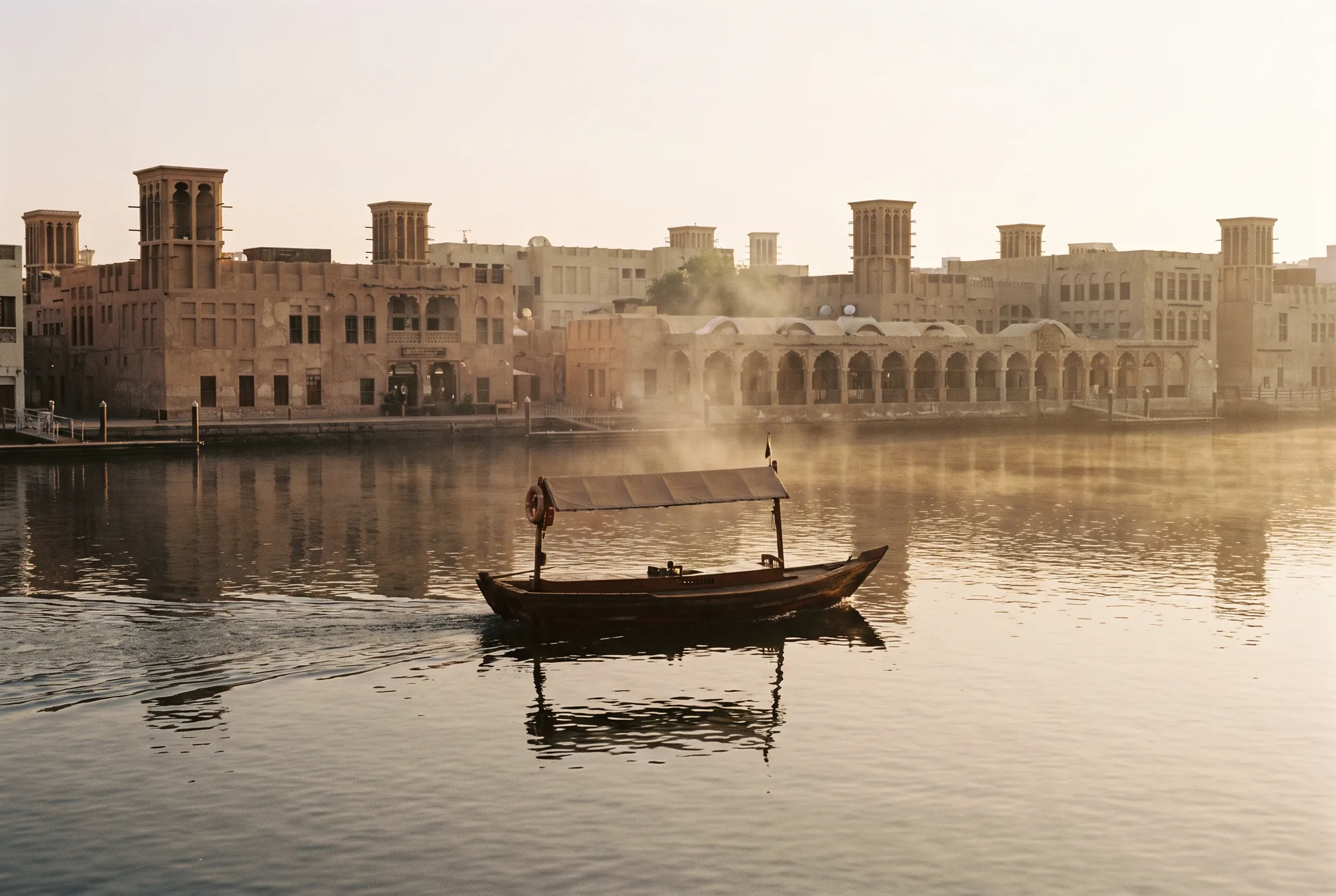
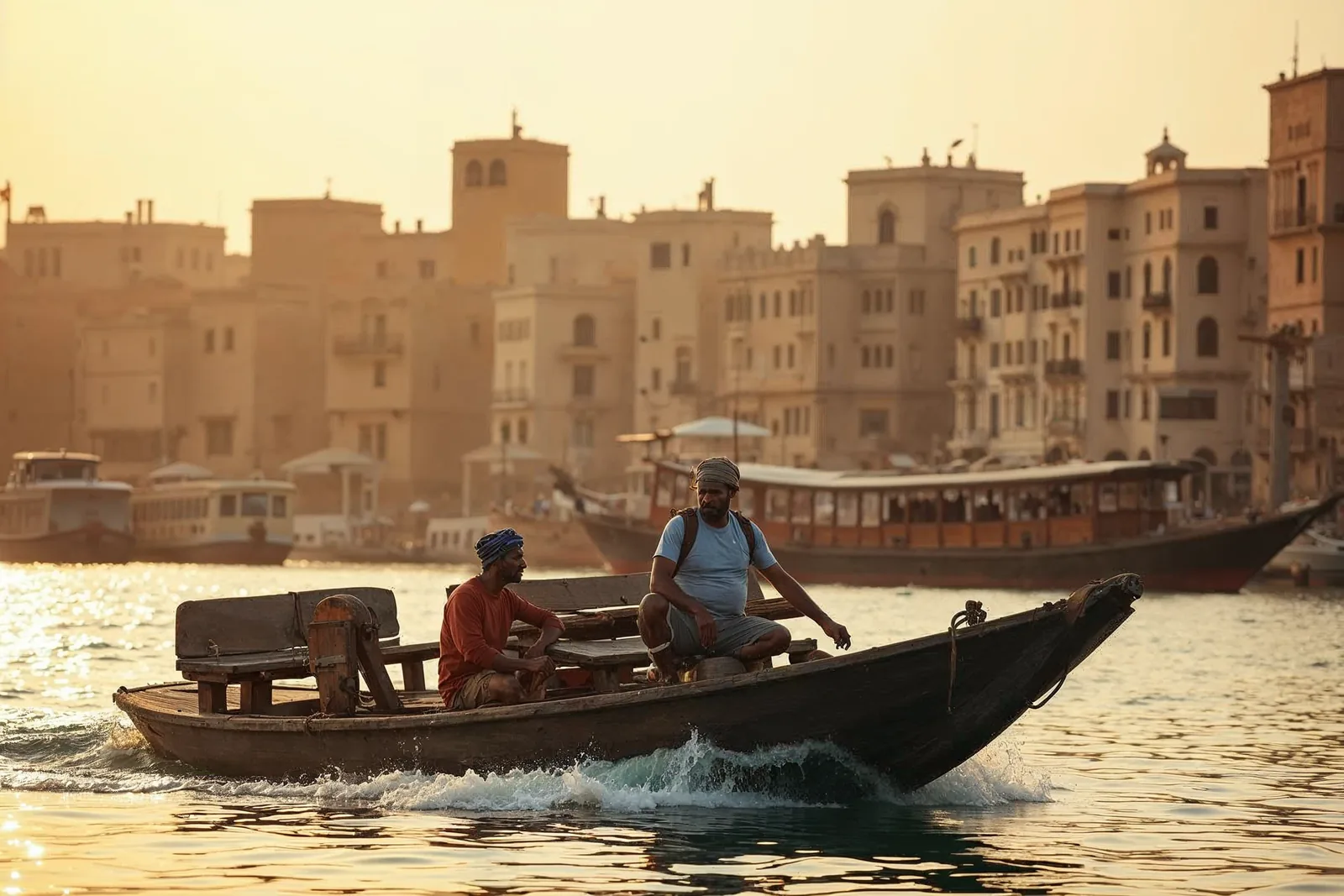
Dubai Creek is a saltwater inlet that cuts the historic city in two (Deira on one bank, Bur Dubai on the other), and for most of the city's life it was the entire point of the place. The way to cross it has barely changed. You step into a wooden abra, a low open ferry with a diesel engine and a bench down each side, and for one dirham the boatman takes you over while traders, office workers and tourists sit knee to knee in the salt air. It is the least glamorous transport in a city obsessed with glamour, and it remains, for our money, the best few minutes you can spend here. Along the wharves, the larger wooden dhows still load up with refrigerators, tyres and crates of dates, bound for ports across the Gulf exactly as their predecessors were a century ago.
On the Bur Dubai side sits Al Fahidi, the old Bastakiya quarter: a warren of narrow sand-coloured lanes and restored coral-and-gypsum houses topped with barjeel, the square wind towers that funnelled any breeze down into the rooms below, the air conditioning of their day. It is genuinely quiet, which in Dubai is its own kind of luxury. Across the creek in Deira the souks unfold: the gold souk, its windows banked in yellow bullion, glitters in a way somehow more honest than the malls, and the spice souk a few lanes over, where the air thickens with saffron, dried lime, frankincense and cardamom. At the Sheikh Mohammed Centre for Cultural Understanding, run under the motto 'open doors, open minds', you can sit on the floor for an Emirati meal and ask the questions you were too polite to ask (about faith, marriage, money, the abaya) over cardamom coffee and dates.
What the old city actually tells you
It is worth understanding what you are looking at, because the history reframes everything that came after. Long before oil, Dubai's wealth came out of the sea. Pearling was the engine of the lower Gulf for centuries: fleets of dhows would sail out for months each summer, the divers going down on a single breath with a stone to sink them and a nose-clip of bone, working the oyster beds until their lungs and eyes gave out. It was brutal, indebted, often fatal work, and it built the merchant families and the trading instinct that still define the place. When Japanese cultured pearls collapsed the market in the 1930s, the town nearly went under with it.
What saved Dubai was not oil so much as the decision, made early and repeatedly, to be the place where everyone else came to trade. The creek was dredged so larger ships could enter; the souks filled with merchants from Iran, India and beyond; the free ports and the airline followed the same logic. So when you watch a dhow loaded by hand on Deira's wharf, you are not looking at a heritage performance. You are looking at the original business model, still running. The towers are the same impulse expressed in steel. Hold both pictures at once and the city stops feeling like a contradiction and starts feeling like a continuous story.
Desert and sea
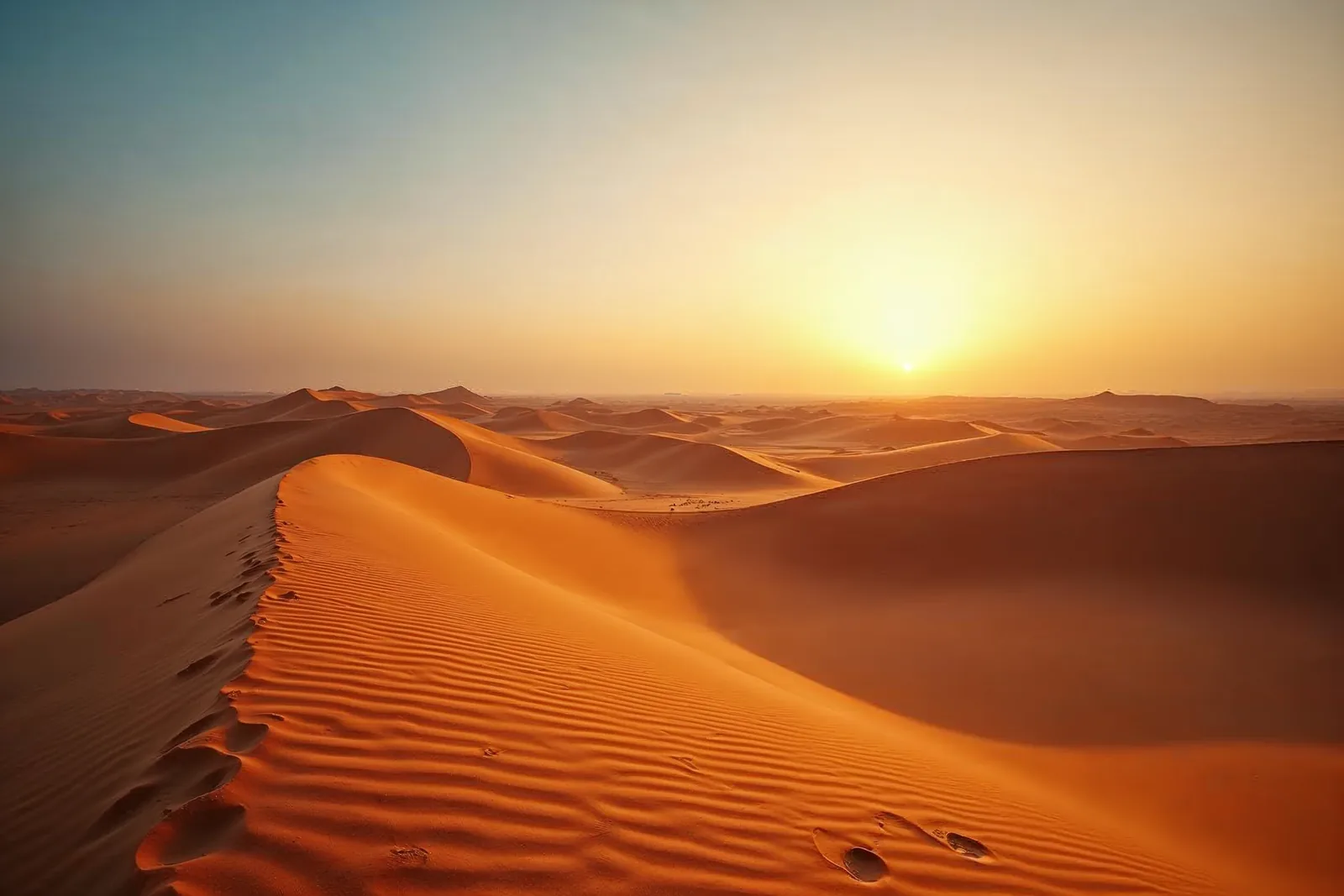
The desert is the other Dubai, the one the Emiratis themselves return to, and we always suggest meeting it the same way: late in the afternoon, privately, with no convoy and no thumping speakers. We drive you past the last of the suburbs, where the road thins and the streetlights give up, to a quiet stretch of conservation reserve held for the evening. The sand at golden hour is a colour photographs never quite catch: ochre deepening to rust, the windward faces still warm under your hand while the lee sides have gone to shadow. What you notice first is how loud the silence is: the dunes absorb sound, so even your own footsteps arrive softened. We like to sit you on a rug with cardamom coffee and dates while the light goes, then stay on for dinner under canvas once the stars come out, and out here, away from the city's glow, they genuinely do.
The desert's older characters are worth the time too. The falcon is not a tourist prop in the Emirates; it is closer to a member of the family, trained to hunt across the dunes through the lean winter months, and the bond runs deep enough that falcons travel on their own passports and ride in aircraft cabins. A morning with a falconer (the weight of a hooded bird on a gloved fist, the stoop to a lure at a speed that genuinely startles you) is the best window we know into the older Emirati character: self-reliant, exacting, and oddly tender toward the animals it depends on. The same thread runs through the camels, the desert's ships long before anyone struck oil; at the racing stables in the cool early hours, robot jockeys now sit where children once did.
Then there is the sea, which Dubai's desert reputation tends to erase. The city sits on the warm, shallow Arabian Gulf, and from roughly November to April the water is swimmable and bathwater-calm, the beaches wide and pale, best in the mornings, before the heat builds. We will be honest about the trade-off: this is not a wild, dramatic coastline, and high summer turns the sea into a warm bath you cannot cool down in. But for a few unhurried hours between desert and city it is close to ideal, and if you want clearer water, coral and proper diving, a short hop to Fujairah on the east coast opens up the Gulf of Oman against a backdrop of bare mountains.
The art of the stopover, and when to go
This is where Dubai earns its keep on a JMJ itinerary: it is not the destination but the hinge. It sits almost exactly between Europe and the Indian Ocean, within easy reach of East Africa, which is why its airport became one of the busiest on earth. And a long flight broken in the middle by a few unhurried days is a far gentler thing than a single punishing haul. Heading to the Maldives, you can fold in two or three Dubai nights at the front and arrive at your atoll already adjusted to the time zone and the heat. The same logic suits an East African safari: Dubai breaks the long journey south, so you reach the bush ready to be awake at dawn rather than fighting your body clock through the first game drive. The contrast is the point: Dubai gives you noise, abundance and warm water; what follows gives you stillness and space, and each makes the other feel sharper.
When you go matters more here than almost anywhere. Summer, roughly June to September, is genuinely punishing: daytime temperatures well above 40°C, often nudging the high 40s, with humidity off the Gulf that makes the open-air city close to unusable in the middle of the day. A summer trip means living between air-conditioned interiors, and the desert and the creek lose much of their pleasure. Come instead in the cooler half of the year, roughly November to March, when days are warm and bright, evenings ask for a light layer, and everything outdoors (the dunes, the abra, a long dinner on a terrace) comes back to life. As for length, two days is enough to feel the city and break a flight; three is the figure we keep returning to, letting you give the old town a proper morning, the desert a proper evening and the beach a proper rest. If you can only travel in summer, we will tell you so and shape the trip accordingly, or gently suggest somewhere else.
Dining, and the late-night rhythm
Dubai eats late, and once you fall into the rhythm it is one of the city's real pleasures. Because so much of life happens after dark (the heat sees to that for half the year), restaurants fill from nine, families are out with children near midnight, and the souks and cafes hum well past the hour you would expect them shuttered. The food is a fair mirror of the population: the city's migrant communities have given it some of the best South Indian, Lebanese, Iranian and Pakistani cooking anywhere outside those countries, often in modest rooms that never make a list, alongside the high-gloss imported names that draw the headlines. Spend at least one evening away from the rooftop dazzle, at a busy Levantine grill or a Persian place thick with the smell of saffron rice and grilled meat. Ask us, or ask a local; the best meal of your trip may cost very little.
Seek out the genuinely Emirati dishes too, because they are quieter and harder to find than the global options. Look for slow-cooked machboos, the spiced rice and meat that anchors a family table; harees, wheat and meat beaten to a comforting porridge; and luqaimat, little fried dough dumplings drenched in date syrup and served with cardamom-scented coffee. Round off a night with shisha and mint tea at a creekside cafe and you will understand why Dubai treats the late hours as the best part of the day rather than the end of it.
Doing it well
The single rule we would offer is to balance the two cities deliberately rather than let the new one swallow your time. It is easy to spend three days here and never leave the air-conditioned circuit of mall, beach club and rooftop. Give the old quarter at least a full morning, ideally a slow one, before the heat builds (the creek, an abra crossing, the souks, a proper Emirati meal rather than another international tasting menu), and let the city's louder pleasures come in the evening, when Dubai comes into its own.
It is also one of the genuinely easy places to travel with children: safe, spotless, endlessly equipped for families, with short transfers and enough variety that a single day can hold a desert dawn, a swim and an evening out without anyone melting down. The trick, with kids or without, is the same: let the spectacle be the dessert, not the meal. Spend your attention on the water, the dunes and the old lanes, and Dubai turns out to have been a real place all along.
Frequently asked
How many days do you need in Dubai?
Three nights is our preferred figure. Two is enough to break a flight and sample the city, but three gives you a proper morning in the old town and souks, an unhurried evening in the desert, a restful day by the sea, and a margin for jet lag to lift before you fly on. Beyond three or four nights, most travellers are ready to move on to quieter ground.
What is the best time of year to visit Dubai?
Roughly November to March, when days are warm and bright and the evenings cool enough for a terrace dinner or a night in the desert. The summer months, June to September, are genuinely severe (well over 40°C with high humidity off the Gulf) and confine you largely to air-conditioned interiors. If you can choose, come in the cooler half of the year; the creek, the dunes and the beaches all depend on it.
Is there anything to do in Dubai beyond the malls and skyscrapers?
Yes, and it's the part we'd point you to first. Dubai Creek, the wooden abra and dhow trading boats, the restored Al Fahidi wind-tower quarter, and the gold and spice souks make up an older, quieter city that most visitors skip entirely. Add a private desert evening at golden hour and a meal in one of the city's excellent, unshowy migrant-community restaurants, and Dubai reveals far more depth than its skyline suggests.
How do you cross Dubai Creek, and is it worth it?
You cross on an abra, a small wooden ferry that runs between Deira and Bur Dubai for about one dirham: a few minutes on the open water, sitting alongside traders and commuters in the salt air. It is the cheapest and, in our view, one of the most memorable things you can do in the city. It also drops you between the souks on one side and the historic quarter on the other, so it doubles as the natural way to see old Dubai.
What is a desert experience in Dubai actually like if done well?
Done well, it is calm and private rather than a noisy convoy of buggies. You head out late in the afternoon to a conservation reserve, watch the light change over the dunes with cardamom coffee, learn a little falconry or Bedouin history, and stay on for dinner under the stars once the city's glow falls away. It is one of the most memorable evenings the region offers, and worth arranging quietly rather than booking the standard mass tour.